Topical pain relief with herbal medicines
Aug 05, 2026
Herbal medicines are often prescribed for internal use for many conditions. I am a big fan of combining the internal application of herbs with topical treatments, particularly in the cases of musculoskeletal (MSK) concerns.
Firstly, let's look at some of the MSK conditions that are well treated and even clinically proven with topical applications and why it is important to consider. Chronic MSK conditions include different types of arthritis, lumbago (lower back pain), fibromyalgia, sciatica and gout as well as bruising, swellings and pain. Each of these complaints can also have acute flare ups of the pain, inflammation and lack of mobility. The frequency and duration of these acute flare ups can be lessened through effective topical treatment at the first sign of a flare.
Patients appreciate the ability to treat themselves, especially when pain arises at inopportune times (when is it ever a good time!?). Having an array of pain relieving topical herbal medicines on hand can really support the reduction of severity and duration of symptoms, as well as supports an individuals confidence in managing pain. We now know that much of the pain sensation is perception, when the body is triggered, the mind can over compensate and the pain felt might not reflect the tissue damage occurring. Educating people on how herbs work to manage acute pain can be so empowering and help better recovery outcomes.
I have personal experience with chronic lower back pain with acute debilitating flares (from a past injury). The ability to reach for a topical relief herbal is so under rated as they can be very effective. Most topical applications can be used alongside stronger internal pain medications if required.
Energetically, the idea is to use cooling remedies in acute flare ups an warming remedies in chronic conditions. Menthol is cooling - Capsaicin is warming. Cooling remedies reduce inflammation by causing constriction and relieving swelling, whilst warming remedies reduce inflammation by improving circulation and removing waste products (generally speaking!).
The main aspects we need to treat in acute MSK pain or chronic pain flares are:
- reducing the inflammatory cascade
- reducing the sensation of pain
- encouraging tissue repair
- supporting localised lymphatic clearance
- mopping up free radical damage
there are more, but these are the main ones to consider.
Thankfully we have some good answers! Most of these can be kept in a medicine cabinet for convenient relief.
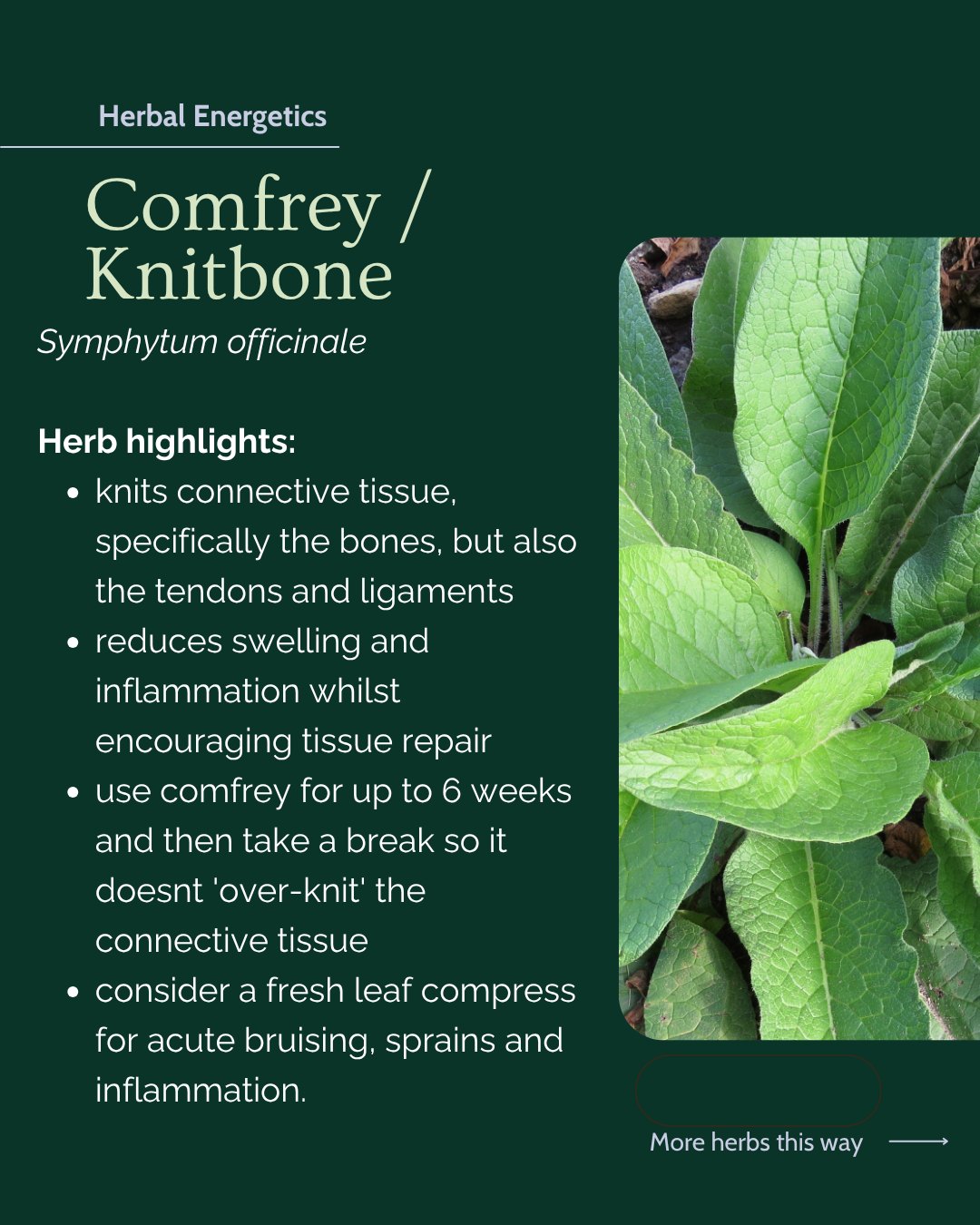
- Comfrey - Symphytum officinale
Known as knitbone, Comfrey does just that. It knits connective tissue, specifically the bones, but also the tendons and ligaments. Comfrey reduces swelling and inflammation whilst encouraging the tissue repair. Creams and ointments are readily available to purchase, but it is so fun to make it yourself as an infused oil turns a lovely deep green colour. Make sure to use comfrey for up to 6 weeks and then take a break from it so it doesnt 'over-knit' the connective tissue. I have used a comfrey compress many times for acute bruising, sprains and inflammations and it reduces it over night. Simply bruise the leaves and apply to affected area, wrap with a bandage and leave it, for a few hours if possible. Here is a cool full article on the many uses of topical comfrey - https://pubmed.ncbi.nlm.nih.gov/22359388/
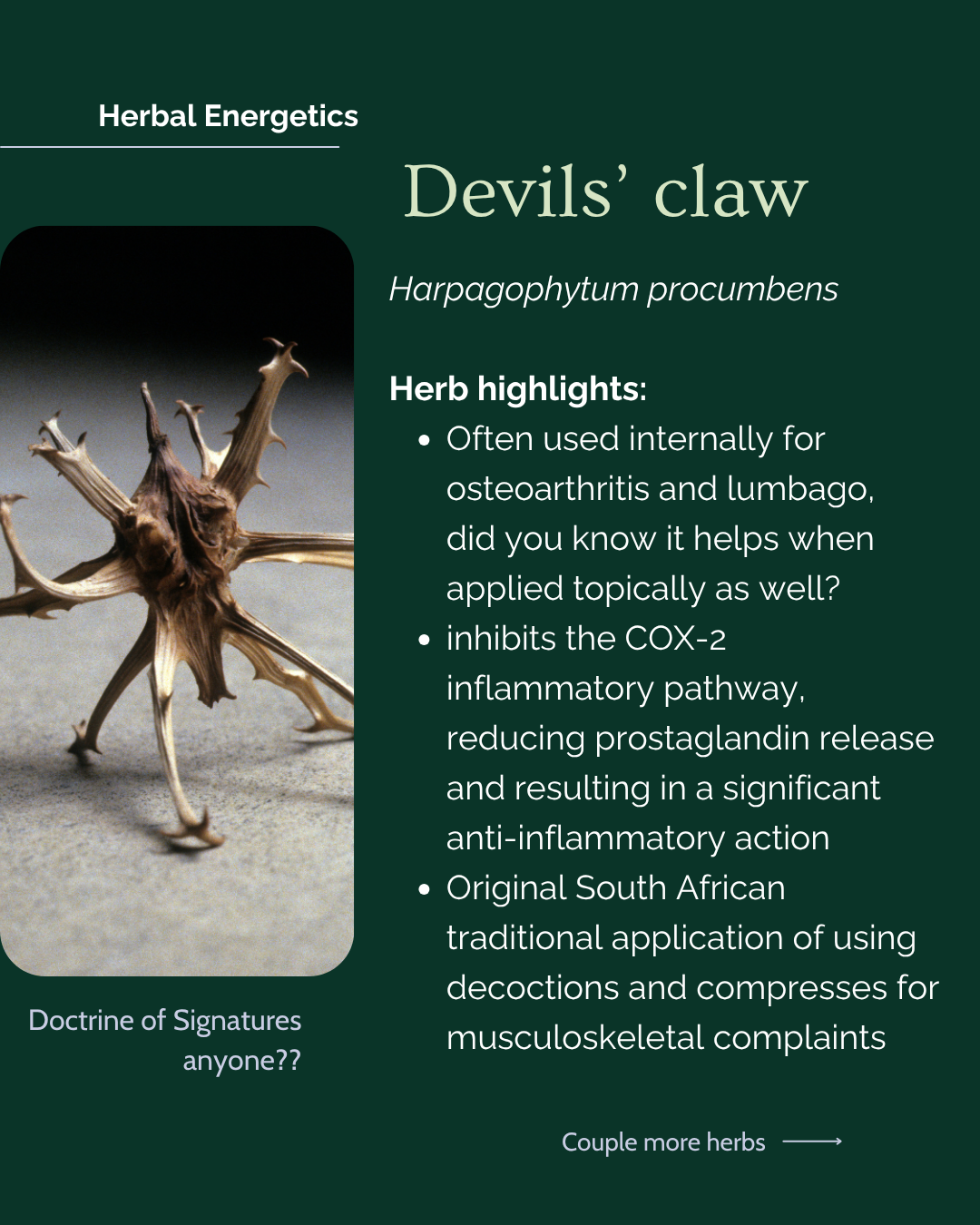
- Devils claw. Harpagophytum procumbens
This lesser-known herb is often used internally for osteoarthritis and lumbago, but did you know there is a strong traditional evidence for pain relief when applied topically as well? Its primary mode of action is by inhibiting the COX-2 inflammatory pathway, reducing prostaglandin release and resulting in a significant anti-inflammatory action. Most studies are on internal use and are shown to be as effective (or more) as standard pain relieving medicines. Often with studies of this nature, it is the post market surveillance study that shows more benefit - this is reviewing the signs and symptoms 6-12 months later. This study highlights the original South African traditional application of using decoctions and compresses for musculoskeletal complaints (amongst other things). This is one area where scientific studies will catch up with the traditional application.
- https://pmc.ncbi.nlm.nih.gov/articles/PMC9182060/
- Capsicum/chilli liniments. Capsicum annum
These are very rubefacient (red-fascia) bringing warmth and circulation to affected areas. Chilli reduces the release of Substance P which reduces the sensation of pain. It therefore helps best where there is nerve innovation associated with the pain - sciatica, pinched nerves, neuralgia, spinal disc concerns etc. However, the safety profile is relevant as it should only be used for up to 6 weeks at a time, with at least 2 weeks break inbetween. Energetically it is very warming - hot and dry - so best for cold presentations and constitutions. Liniments, chilli oil (hot) infusions and ointments are easy to make and very effective for cold pain types - stagnation, stiffness, tension, worse with cold or dampness and better for heat. The main active constituent - capsaicin - is an alkaloid that does most of the heavy lifting, so you might see commercial creams with capsaicin in combination with other herbs (or glucosamine). It reduces inflammation but also provides analgesic (pain relieving) actions.
Check this study out for all the nerdy details - https://pmc.ncbi.nlm.nih.gov/articles/PMC7969397/
- Arnica. Arnica montana
Available as a topical cream, or homoeopathic for internal use. Do not let this herb get inside as it will do its best to scramble the DNA. Make sure to avoid use on broken skin. Apply to bruising, swellings and deep seated aching for acute or chronic relief. In one study the topical application was shown to be as effective as ibuprofen. Thankfully they can be used together to potentiate each other in acute pain
- Willow bark. Salix alba
Willow has specific tissue affinity with the MSK system, meaning it knows exactly what the target mission is and carries it out directly. Often used internally, it can also be applied topically to reduce inflammations and assist tissue repair. Salicin was the active component extracted from Willow to birth Aspirin. Most evidence lies with internal use, however, traditionally is has been used topically so again, science will catch up - here is an 'innovative' article https://pdfs.semanticscholar.org/0e43/bf1123effc01e9837fa7ad2dc2382c2f1410.pdf
- Boswellia. Boswellia serrata
Well known to be effective for internal use in MSK conditions. Boswellic acids have been shown to decrease inflammation, reduce oxidative damage and improve tissue repair. It does this by inhibiting the LOX pathways of inflammation whilst also inhibiting NF-kB and TNF-a resulting in a well rounded systemic reduction of inflammatory pain states. The tissue repair aspects is of importance here. This is a highly resinous herb so difficult to extract in water-based preparations, however, an oil extract will capture the resins, or use the fluid extract in a cream. Combine with Turmeric for optimal effects (these two get on very well together). https://pmc.ncbi.nlm.nih.gov/articles/PMC9984289/
https://pmc.ncbi.nlm.nih.gov/articles/PMC7545864/
- St Johns wort. Hypericum perforatum
Not just for mood! St John's wort is also a wound healing nervine. Suitable for chronic pains that are made worse due to stress. The homoeopathic of St John's wort is specific for spinal subluxation pain with a nerve component. Traditionally, the herbal preparation was used for sciatica, when I was studying, this was one of its primary uses! Studies are limited for this, but try it and see for yourself!
- Peppermint. Mentha X piperita
It is more the Menthol that we are after here, so the essential oil of peppermint will be more potent for pain relief. It is best for acute pain as it is quite cooling to the area. Had to mention this as menthol is widely used in commercial preparations. I will delve into topical essential oils at another time..
- Baths with epsom salts.
The traditional magnesium method, epsom salts contain magnsium and sulphate which help to relieve muscle spasms, reduce inflamation and reduce oxidative stress by improving elimination channels. A warm bath improves circulation, reduces inflammation and eases muscle tension to help movement and mobility. Most studies on using baths for MSK pain show sustained results 6 months post treatment intervention. Consider a full bath, sitz bath (for pelvic pain), a hand bath (for Carpel tunnel, hand osteoarthritis), a foot bath (for gout, plantar fasciitis) or an ice bath for acute tissue damage.
https://pmc.ncbi.nlm.nih.gov/articles/PMC6750337/
https://www.cochranelibrary.com/cdsr/doi/10.1002/14651858.CD006864/full
- Creams, ointments, compresses or sprays?
Whichever suits the area you are treating and the ability to apply them. Consider adding herbs to a cream with about 10% dilution; essential oils are up to 5% dilution for targeted treatment areas. Compresses are easily made and a great way to apply herbs (consider all of the herbs as well as ginger, turmeric and rosemary). Some herbs can be applied directly such as comfrey fresh leaves, St John's wort infused oil and Boswellia oil.
- Some great commercial readily available herbal medicine products.
These are good to know for convenience, when travelling or for shelf stable preparations to have on hand.
Traumeel - Available as a cream or gel, this is a clinically proven homoeopathic and herbal preparation that takes the tension as well as the sting out of MSK pains.
Fisiocrem - Contains herbs for nerve and muscle pain.
Kunzea - by Zea. An Australian herb that is showing great evidence in topical application for relief of muscle, joint and nerve pain.
Magnesium sprays - For harder to reach areas, best used in skeletal muscle spasms.
Tiger balm - A staple for many. Warming and analgesic pain relief.
Pain relief patches - These may include herbal medicines (typically chinese herbal formulations) or you can use the self-heating patches. These are great for all day relief and I recommend to take some with you when travelling. Self-heating patches can be used for all types of smooth muscle pain and cramping (including period pain).
- Therapeutic touch.
Experiences of pain can cause a person to disconnect or disassociate from their body to try and escape the pain sensation. There is power in gentle application of topical creams, compresses and patches for pain relief. Touching the affected area with healing intentions can reconnect you with feeling safe and well in your body again after long term pain. Combine with mindfulness approaches and breathing exercises for optimal physical reassurance and reducing the perception triggers for pain flares.
This list is a start - there are many more herbs that can be used topically for pain relief such as CBD oil, essential oils, Valerian for smooth muscle spasms and of course the well-known Turmeric. Turmeric is written about so much I wanted to highlight some lesser known herbs here.
These herbs are suitable for use on animals too. I used Traumeel in combination with comfrey ointment for my dog when he had cruciate ligament surgery and it really helped him to relax and heal quicker. Animals respond much quicker than humans do to topical herbal treatments. This combined with the power of healing hands makes such a huge difference.
Let me know what works for you!